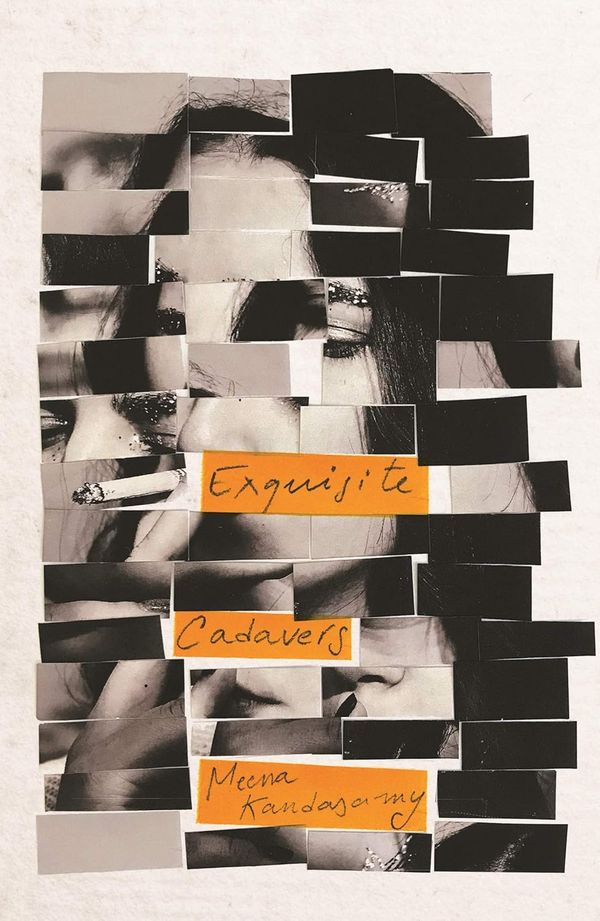
Exquisite Cadavers
“Slyly funny and profoundly thoughtful … not just a fierce rebuttal. It’s a work of brilliance.”
Longlisted, Swansea University International Dylan Thomas Prize 2020 · The Asian Writer’s Writer of the Year, 2019
Karim and Maya share a home, worry about money, binge-watch films, and love, quarrel, fight and argue all the time. Karim, a young film-maker, carries the starry-eyed dreams of the Arab Revolution. Maya carries her own pressing concerns: an errant father, an unstable job, a chain-smoking habit, a sudden pregnancy. When Karim’s brother disappears in Tunis and Karim wants to go after him, Maya must choose between her partner and her home city, her future and her history.
In a conversation between forms, fictions and truths, Exquisite Cadavers is a novel about a young couple navigating love in London — and, running in its margins, a literary hall of mirrors about an author navigating the inspirations behind her work.
“This spiky, argumentative book is the novel as protest, as polemic, as dark comedy, as game.” — Aida Edemariam, The Guardian
“Does it surprise, grip, make the reader take notice — all those things literature is supposed to do? Easily, yes, yes, and yes again.” — The Irish Times
“A backflipping rebuke to the nexus of culture- and capital-making … It is a joy.” — Stephanie Sy-Quia, Los Angeles Review of Books
“In Kandasamy’s bold, inventive latest (after When I Hit You), a young couple struggles with the pressures of domestic life and Islamophobia in London … Kandasamy renders the couple’s experience and perceptions through an effective experiment: the text is divided into two columns on each page, with Maya and Karim’s story offset by a parallel narrative in the margins consisting of Kandasamy’s notes on her own life and her ideas about the characters, and details of violence against women in her native India. As Karim rushes back to Tunis after his brother is falsely arrested and possibly killed, Maya considers joining Karim, asking herself, ‘What’s the worst that could happen?’ It’s a chilling question in the context of Kandasamy’s commentary on violence and political displacement. This is both an excellent exercise in form and a deeply evocative love story.” — Publishers Weekly
Read John Self’s interview with Meena Kandasamy in The Guardian, and cover designer Carmen R. Balit in Spine.